
Book Review: The Culture Map — Navigating Collaboration Across Borders
I grew up in the east of the Netherlands — a region most people outside the country wouldn’t recognize, and even inside the country it’s often dismissed as “that farmers side.” My hometown had around 150,000 people: big enough to feel alive, small enough that the local bakery still knew your name. Most businesses were locally rooted, though always tied in some way to the massive Ruhrgebiet just across the German border. You can feel that cross-border DNA everywhere.
Why am I telling you this? Because where you grow up shapes how you show up — especially in business. The Dutch are known worldwide for their directness, something that can feel brutally honest to outsiders. And even within the Netherlands, the east has its own flavor of straightforwardness. We grew up with sayings like “Doe normaal, dan doe je al gek genoeg” — basically: act normal, that’s crazy enough. It’s a philosophy disguised as a joke.
Working internationally taught me how much that cultural software matters. At one of my jobs we had a small book club, and someone recommended The Culture Map. I still remember reading it on a flight to Toronto for a business trip. That book has stuck with me ever since. I still grab it now and then to understand how a new colleague or client might interpret what I’m saying.
For anyone leading cross-border projects, financial planning sessions, or strategic discussions — this book is highly recommended.
The Big Idea
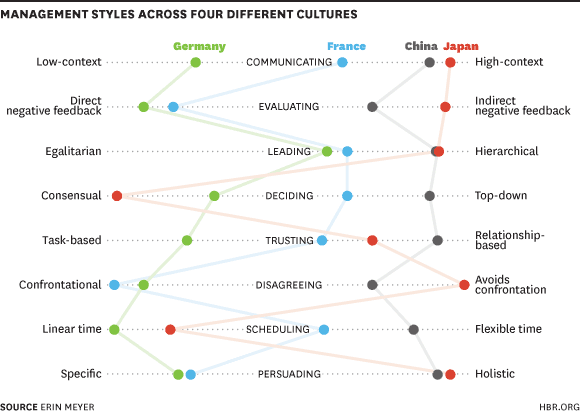
Meyer identifies eight cultural dimensions that shape how we communicate and make decisions: from how we give feedback and perceive hierarchy, to how we schedule time and build trust.
Her research at INSEAD shows that none of these styles are “right” or “wrong” — just different. Understanding them allows leaders to decode misunderstandings that can derail meetings, forecasts, or partnerships.
Why It Matters for Business and FP&A
In financial and strategic planning, numbers only tell half the story.
The other half is interpretation — and interpretation depends on culture.
A single dashboard can spark totally different discussions in Paris, Berlin, or Singapore.
Meyer’s framework helps teams spot those cultural gaps before they become project gaps.
For example:
-
A Dutch manager might assume everyone will challenge a forecast openly.
-
A Chinese or French team might see open disagreement as disrespectful.
-
The result? Silence that looks like agreement, but isn’t.
Understanding those differences can transform how you run reporting meetings, set targets, and align strategy across borders.
Favorite Insight
“The biggest mistake is believing that your own cultural norms are universal.” — Erin Meyer
That line hits home for anyone who’s ever sat in a meeting wondering why a partner “doesn’t get it.” They probably do — they just show it differently.
Our Take
At Budelco, we think The Culture Map should be required reading for anyone managing multi-country reporting or data-driven strategy. It reminds you that behind every KPI is a person — and behind every person is a cultural context.
If xFP&A is about connecting business functions, this book is about connecting the people behind those functions.