
The Dunning–Kruger Effect in Business: How Overconfidence Skews Strategy and Financial Decisions
remember the elections that followed the COVID years vividly.
The debates, the campaigns, the endless opinions — suddenly, everyone seemed to have become an economist.
Inflation and even greedflation were the words of the year. Wherever you went, people talked about it: at dinner tables, on television, and in office kitchens.
One evening, I found myself discussing it with my brother.
We grew up in a financially literate family, where elections were never just about ideology or emotion. They were a rational exercise — a matter of weighing budgets, policies, and numbers. Give something here, take something there. In my view, when a country is financially healthy, most problems become disturbances rather than crises. So when I think about politics, I focus on how we can grow as a country — how to maximize output, spending, and opportunity.
Our discussion was like most of our debates: lively, analytical, and 95% in agreement. When we don’t agree, we reason our way toward common ground. It’s easy when the other person thinks the same way you do.
That evening, our conversation turned toward the broader public — how ordinary people are expected to decide on complex issues like inflation. My brother pointed out how many politicians had built their campaigns around the fear of it — a populist but effective theme. Everyone felt the pressure at the supermarket checkout, but very few truly understood why prices were rising.
“That’s the Dunning–Kruger effect,” he said suddenly.
And that’s when I first learned about the Dunning–Kruger effect — a fascinating, slightly uncomfortable, but profoundly true reflection of how we all perceive our own understanding.
What the Dunning–Kruger Effect Really Means
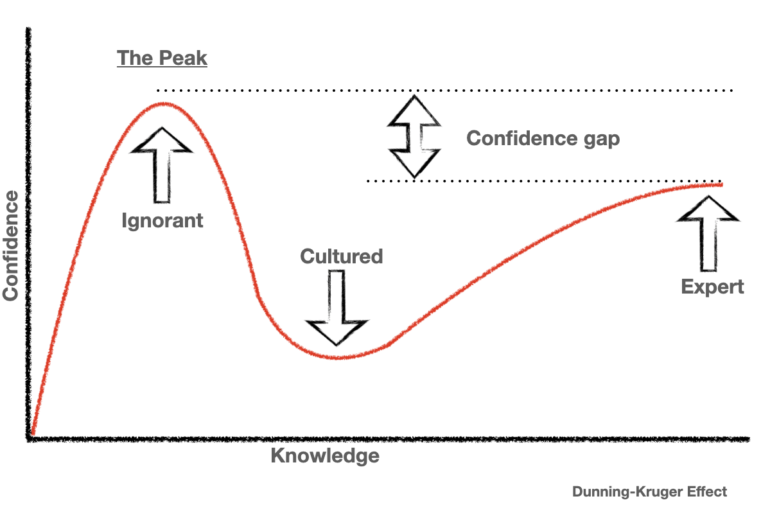
The Dunning–Kruger effect is a psychological phenomenon where people with limited knowledge or experience tend to overestimate their own competence.
In short: the less you know, the more likely you are to think you understand.
It comes from a 1999 study by David Dunning and Justin Kruger at Cornell University, which showed that people who lack skills often fail to recognize their own shortcomings — while the truly competent tend to underestimate themselves.
As Dunning once put it:
“The trouble with ignorance is that it feels just like expertise.”
From Elections to Economics
You could see this effect everywhere during the campaign season.
Everyone had an opinion about inflation, interest rates, and government spending — but few grasped how deeply interconnected those forces are.
Inflation is driven by a web of international markets, monetary policy, production costs, wages, and consumer confidence.
And yet, in politics, it’s often boiled down to a simple headline: “It’s the government’s fault.”
Simplicity sells — especially when the world feels complicated.
The Dunning–Kruger Effect in Business
Since that conversation, I’ve started seeing the Dunning–Kruger effect in business, too.
In boardrooms, strategy meetings, and data discussions, the same pattern emerges:
-
Those with limited insight often make bold, confident claims.
-
Those who dig deeper into the data realize how much they don’t know.
It explains why some entrepreneurs rely purely on gut feeling (“I just know this will work”), while others get lost in analysis paralysis.
The truth, as always, lies somewhere in between: knowledge without arrogance, and doubt without fear.
Strong leaders understand that they don’t have all the answers — and that awareness makes them far more effective.
They invite challenge, ask better questions, and build teams that fill in their blind spots.
Knowledge, Humility, and Progress
The Dunning–Kruger effect isn’t meant to insult anyone — it’s a mirror.
It reminds us that confidence can’t replace competence, and that genuine expertise requires humility.
Whether in politics, economics, or business, the people who keep learning are the ones most aware of how much they still have to learn.
And maybe that’s the real takeaway from that election:
understanding the limits of what we know might just be the smartest vote we can cast.